
Prime Minister Mark Carney has so far declined to accept the trade terms on offer from Washington and has cast Canada as the smaller country standing up to a much larger neighbour. The U.S. president is predictably unpredictable. Carney, by contrast, is calm, collected and riding a wave of national sentiment. Canada-U.S. trade talks have broken down, although Carney says Canada remains prepared to make a deal that benefits both countries.
At the same time, Mr Carney has positioned himself internationally as a leader among the middle powers. Other countries may applaud. But Canada has more to lose than most from a fractured relationship with the United States. Carney himself has argued that middle powers need to work together rather than negotiate individually from positions of weakness.
The idea that Canada, whose economy is less than one-tenth the size of America’s, can win a prolonged economic battle with the United States seems unrealistic. We do not yet know whether Carney is simply a very good politician, whether his strategy will work economically, or whether he is waiting out the current U.S. administration while trying to internationalise Canada’s economy far beyond the United States.
Canada looks good at the moment, but some of that may be fortunate timing. Ottawa is projecting a federal deficit of roughly $65 billion for 2026–27 — about $6,300 for a family of four. Higher oil prices have also improved Canada’s terms of trade and fiscal outlook. The unfortunate scenario would be for oil prices to fall at the same time as the U.S.-Canada trading relationship worsens.
The trade rupture has pushed us into what I call an involuntary Canexit, borrowed from Brexit. Nobody voted to weaken access to our largest market. A foreign manufacturer may be hesitant to put a manufacturing facility in Canada without free access to the US market.
And with Canada there is always an interprovincial complication. Supply management remains politically sensitive. A harsh critic might reduce one recurring regional tension to Quebec cheese versus Ontario cars. Crude, perhaps, but it captures the political difficulty of balancing national and regional interests.
Carney is moving at breakneck speed and has slaughtered several Liberal holy cows.
The proposed increase in the capital-gains inclusion rate was abandoned. In 2025 Carney described China as Canada’s biggest geopolitical threat; by January 2026 he was forging a new strategic partnership with Beijing. Relations with India have warmed sharply, while Canada is simultaneously moving closer to the European Union. Conventional energy and major resource projects are also back at the centre of the investment pitch.
There is even an irony in Ottawa’s new approach. Carney promises that the CRA will now prioritise advance tax rulings for investments of $1 billion or more. In other words, big money gets priority treatment.
Canada wants to become a major importer of capital. It has yet to give Canadians enough reason to keep more of their own capital here.
That matters because Canada’s fundamental problem is productivity. Diversifying trade toward Europe and Asia is useful, but farther markets often mean higher transportation and logistical costs. Higher productivity is needed to pay for them.
I like metaphors.
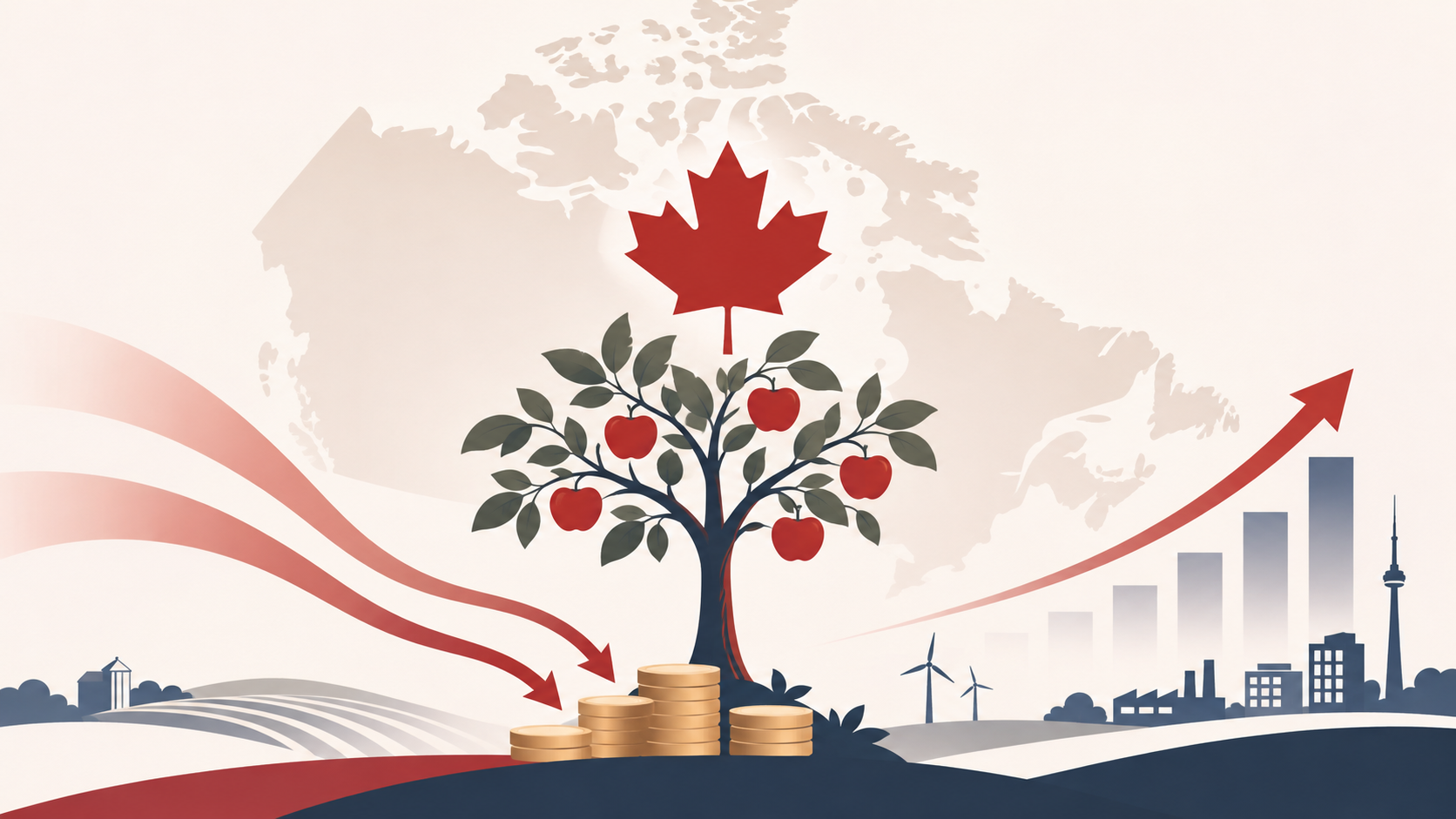
Imagine you plant a seed and grow an apple tree. The tree is your capital. It produces 100 apples a year. Those apples are your income.
Someone offers to buy the tree because he can make it produce 200 apples. Society gets more apples, the new owner earns more income, and more tax can ultimately be collected.
But if the tax cost of selling leaves you unable to reinvest the proceeds productively, you may simply keep the tree.
The result? 100 apples instead of 200.
Taxes do not merely collect revenue. They change behaviour.
The previous government wanted to increase the capital-gains inclusion rate. Carney did not proceed with it. Why stop there?
Canada could look at ideas tried and tested elsewhere.
- Lower the capital-gains tax burden. Switzerland generally exempts capital gains on privately held movable assets such as securities. Canada does not have to become Switzerland, but a lower inclusion rate would send a clear message: successful investment is welcome here.
- Give new residents a temporary tax window. The United Kingdom gives qualifying new residents four years of relief on eligible foreign income and gains. Canada could consider something similar to attract entrepreneurs, investors and highly skilled professionals. Sometimes collecting less today may produce more tomorrow.
- Reward people who build businesses. Imagine, deliberately exaggerating, that an entrepreneur creates 1,000 jobs for ten years. If each job produces $25,000 a year in taxes paid and public support avoided, the hypothetical fiscal benefit is $250 million. If favourable capital-gains treatment later costs $30 million, was that unfair?
Fairness cannot be judged only by asking how much tax a successful person paid. We should also ask what was created.
- Compete for talent. Sweden offers targeted tax relief for certain foreign experts, researchers and executives. Canada is not merely competing for companies. It is competing for the people who create them.
- Compete for intellectual property. Ireland provides preferential treatment for qualifying income from patents, copyrighted software and other eligible intellectual property. In an AI and software economy, the question is not only where an idea was invented, but where its owner chooses to keep, develop and commercialise it.
- Reconsider withholding taxes on new foreign investment. If Canada is asking the world to finance our infrastructure, we should examine whether lower or abandoned withholding taxes wouldn’t be better than supplying quick tax rulings, which may not solve the underlying issue.
- Help Canadians invest in Canada.
The 2026 TFSA limit is $7,000. Increase it. Capital is labour’s best friend. The more capital, the cheaper it is to invest in productivity-increasing ventures, which leads to higher wages.
Sweden’s ISK offers another model. There is no comparable upper balance limit. For 2026, the first SEK 300,000 (CAD 42,500) of qualifying savings is effectively sheltered, while the relevant amount above that threshold faces a standardised annual tax of 1.065 per cent rather than separate taxation of every dividend, interest payment and capital gain.
Canada should at least ask whether its system could do more to help Canadians accumulate investment capital.
Before asking the world to invest here, give Canadians every reason to do the same.
None of this means running larger deficits. If we want to tax productive investment less, we should be willing to shift some taxation elsewhere.
A somewhat higher HST, offset by credits for lower-income Canadians, could create room for lower taxes on investment and perhaps ordinary income.
The objective is not simply lower taxation.
It is better-designed taxation.
Ottawa’s Productivity Mega Deduction may help. But a deduction is useful only after somebody has decided to invest. It does nothing for the factory never built, the mine developed elsewhere, the researcher who moves away or the Canadian investor who sends capital abroad.
Government can improve the return on an investment.
It cannot substitute a tax deduction for confidence.
Carney is trying to attract capital.
Good.
But the ambition should be larger than persuading investors to choose individual Canadian projects.
The goal should be to create a country in which Canadians and foreigners alike look at the tax system, resources, workforce, productivity and access to markets and conclude:
This is where I want to invest.
Capital is mobile. Talent is mobile. Intellectual property is mobile.
Canada competes for all three whether we acknowledge it or not.
We cannot tax investment into existence. But we can certainly tax it out of Canada.