
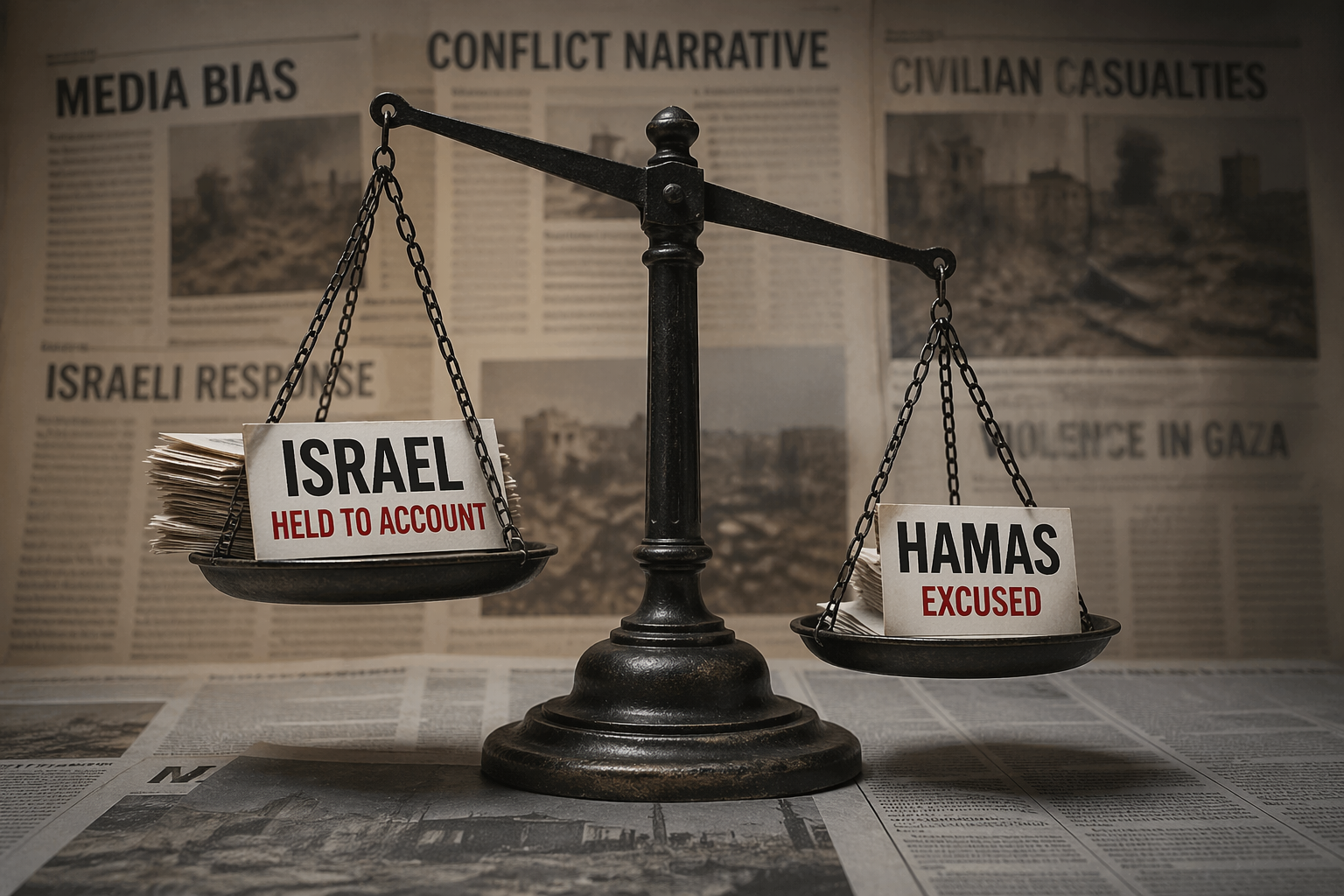
This opinion piece was originally written as a response to an editorial published by Dagens Nyheter (DN) on 5 January 2026 concerning “peace in Gaza.” DN, Sweden’s newspaper of record didn’t like criticism and refused to publish it. DN is equivalent to the New York Times.
What follows, however, addresses a problem that is not uniquely Swedish.
On the contrary, DN’s framing of anti-Semitism and the Gaza war mirrors a broader and increasingly uniform narrative found across Western mainstream media — from The New York Times to the BBC, CNN, and even United Nations communications. The language varies slightly, but the structure remains consistent: Israel is treated as a moral actor whose intentions must be interpreted generously, while Hamas is treated as a pathological force whose stated goals can be safely ignored.
This pattern produces a persistent moral asymmetry — one in which Israel is judged by outcomes, Hamas by excuses, and anti-Semitism disappears when it is rebranded as “anti -Zionism.”
DN is therefore not an outlier. It is a representative case.
What follows is an examination of how this “half-equation” framing operates, why it distorts reality, and how it contributes — intentionally or not — to the normalization of anti-Semitism in respectable public discourse.
DN’s editorial on “peace in Gaza” suffers from a problem that has long characterized its treatment of Israel: it is content with half the equation.
The other half — anti-Semitism, Hamas’s stated goals, and the existential threat to Israel — is treated either as background noise or as something not considered to be of decisive importance.
This is nothing new.
In a DN editorial on 8 October 2002, Göran Rosenberg wrote:
I have long argued that anti-Semitism is not primarily a Jewish problem and therefore not something Jews should waste their energy on.
If a large group of people decided that anyone whose surname begins with R and ends with Berg should not have the same rights as others in society, would Mr Rosenberg have argued that this was not something those affected should “waste their energy on”?
This reasoning is only possible if one regards anti-Semitism as a social problem in the abstract, rather than as a threat directed at actual people. When a group is systematically singled out, threatened, attacked and in some cases murdered precisely because of who they are, it is obviously also their problem. To deny this is to morally absolve the perpetrator and, at the same time, reprimand the victim.
DN should bear in mind that this also applies when anti-Semitism is hidden behind the label ‘anti-Zionism’. If a self-proclaimed anti-Zionist cannot – or refuses – to name which state in the Middle East is the most inclusive, has the greatest diversity and the least apartheid-like structures, then they have in practice identified themselves as anti-Semitic.
Approximately 20 per cent of Israel’s population consists of Muslim Palestinian citizens. A good sign that peaceful coexistence is possible with willing Palestinians is precisely that these citizens could act as a fifth column and destroy Israel through civil resistance. The fact that they do not do so is probably because they do not want to live under Hamas rule.
These citizens are not subject to compulsory military service, but many choose to serve in the IDF voluntarily. In what other country in the Middle East do you see Jewish and Muslim soldiers fighting side by side? In what Muslim state is there an equivalent to a Palestinian judge sentencing a sitting president to prison for sexual assault? And by the way: where are the Jews in these states?
In DN’s Gaza editorial, we once again find only half of the equation.
Through its leaders, Hamas has expressed its desire to repeat 7 October – again and again. This means that it is not seeking a two-state solution, but a single state: judenrein. Where does DN stand on this issue?
Where does DN stand when Hamas political leader Ismail Haniyeh says: ‘The blood of women, children and the elderly – this is the blood we need to awaken the revolutionary spirit in us’?
Those who do not want to see the whole picture can also ignore the billions of dollars in aid that have been squandered on a life of luxury and an extensive network of tunnels for terrorist activities – deliberately built under civilian targets, including hospitals and schools, to maximise the civilian casualties that Hamas cynically uses as human shields.
Those who do not want to see the whole picture can also ignore the fact that Israel has urged civilians to flee combat zones – often prevented by Hamas. ‘Stay away to live for another day.’ Then only the destruction is noticed, even though buildings can be rebuilt.
Those who do not want to see the whole picture also refuse to ask themselves what would have happened if Hamas had offered its victims a choice on 7 October: all property destroyed, but their lives spared.
The more brutally Hamas acts – against Israeli civilians and against its own population – the greater responsibility DN places on Israel to be restrained, willing to interpret and seek compromise. Hamas’ words are reduced to ‘rhetoric’ or ‘mental reservations’. Israel’s actions, on the other hand, are seen as proof of guilt.
No other violent actors are given this privilege of interpretation.
The fact that Hamas does not want peaceful relations with Israel, does not want to disarm and does not want direct contact with the ‘Zionist entity’ becomes, in DN’s analysis, a reason for Israel to unilaterally withdraw.
The Arab League – and not least Qatar and Turkey, hardly pro-Israeli states – on the other hand, demand that Hamas both disarm and relinquish all political power.
In practice, DN seems to believe that Israel should live with an organisation that:
- openly denies its right to exist
- has carried out mass murders of civilians
- expressly states its intention to repeat these acts
Demanding this of any state is not peace work. It is normalising terror as a political tool.
When DN also insists on strictly separating anti-Zionism from anti-Semitism without analysing how these interact in practice, it contributes to making anti-Semitism socially acceptable and morally invisible – as long as it is dressed up in political terms
Is it perhaps the case, DN, that if Jews should not waste their energy on anti-Semitism, then Muslims should not waste their energy on Islamophobia either?
Criticism of Israel is legitimate.
Moral asymmetry is not.
The day DN applies the same rules of interpretation, the same standards of responsibility and the same moral yardstick to Hamas as it does to Israel, it will have left half the equation behind.